
Dendrobium
Dendrobium Species & Hybrids

(Den. Penang Little Magic × Den. Blue Twinkle)
Blooms in sprays of several small, twisty flowers, typically in combinations of pink, magenta, merlot, and rose.
Grown from seed, so flower characteristics vary from plant to plant. Bloom spikes from three individuals are pictured.
Plants Available: Growing in 3” and 4” pots. Orders will be filled with plants in spike/bud/flower as blooming season and blooming stock permit; otherwise, mature plants that have bloomed previously. An example of the 4” Pot - Large option is pictured.
Orchid Care: Grow in bright, indirect light and moderate humidity. Plants can be acclimated to some direct sun but should be provided filtered light during the hottest hours of the summer day. Roots and mix should be allowed to dry out between watering.
Plants may be grown potted or mounted. When potting, use a medium aggregate bark mix and choose a pot that will keep the plant snug. Repot only during spring and summer when plants are actively growing.
—
09.11.26
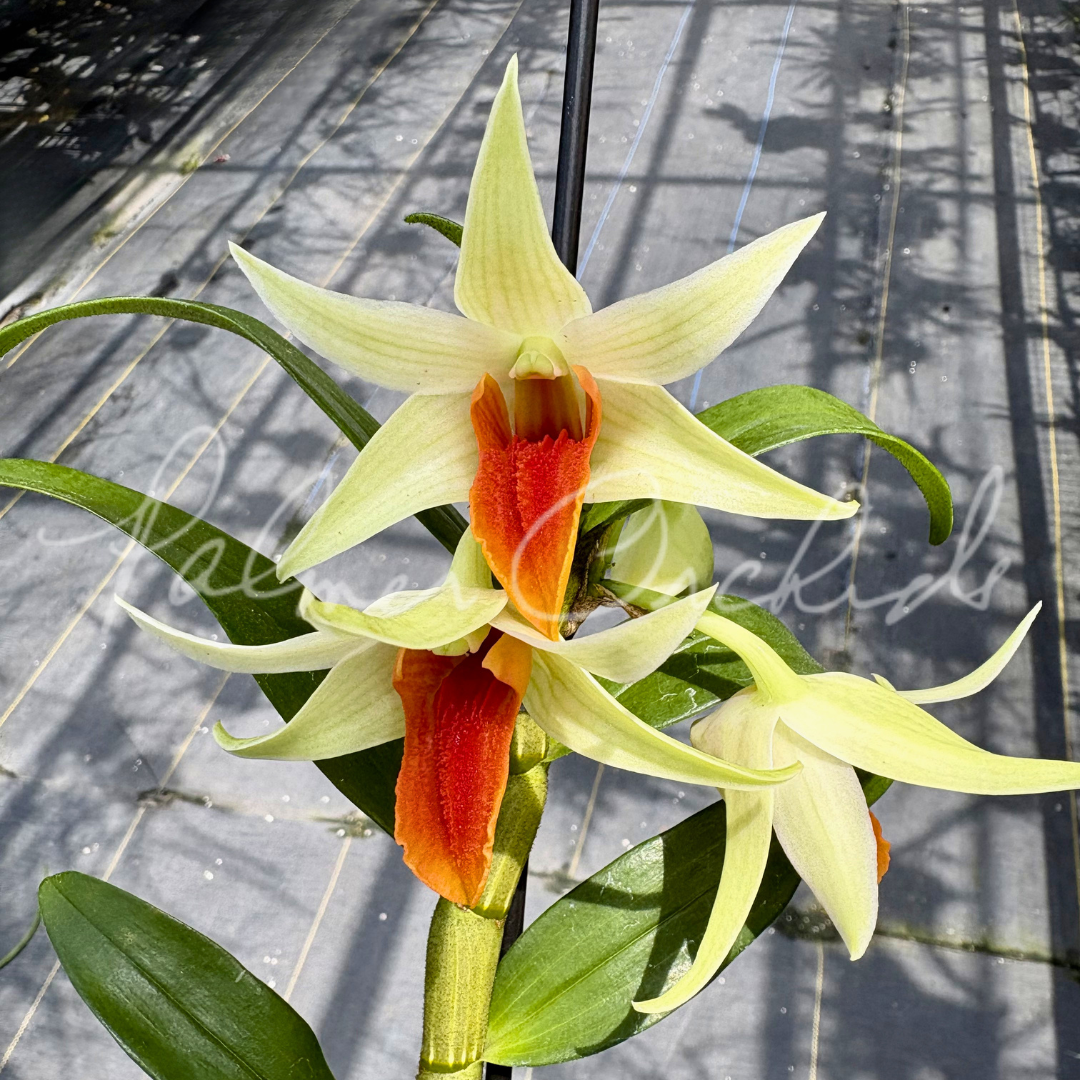
(Den. Hsinying Frostymaree × Dendrobium tobaense)
Dendrobium section Formosae hybrid, with creamy light green petals and a red-orange lip.
‘Red Lips’ mericlone.
Plants Available: Growing in 2” pots. Plants are blooming-size. Examples of the size available are pictured. Orders will be filled with plants in bud or bloom as blooming season and blooming stock permit.
Orchid Care: Grow in bright, diffused light. Keep moist in spring and summer while plants are actively growing. If potted in an open mix that drains freely and does not easily saturate, you can even grow them alongside your Vandas, watering daily. Reduce watering somewhat during the cooler months, but plants are evergreen* and do not require a dry rest. Plants should be tight in their pots.
The canes of this variety are naturally semi-pendulous when not staked or tied upright. Bear this in mind as the new growth emerges. Staking or allowing the growths to cascade is simply a matter of preference since the new growth will be self-supporting.
*Note: Although this is not a deciduous variety, some leaf drop is normal, particularly in response to stress. It is common for the canes on Formosae-type Dens like this one to shed a few leaves after shipping. Just give them a good watering and protect from extremes (e.g. in terms of light and heat) while they acclimate to your growing space.
-
06.13.26

(Den. Betty Goto × Dendrobium canaliculatum)
Compact antelope Dendrobium with indigo-purple flowers.
Grown from seed, so flower characteristics may vary plant to plant.
Plants Available: Growing in 4” pots. An example of the 4” Pot option is pictured. Orders will be filled with plants in spike/bud/bloom as blooming season and blooming stock permit; otherwise, mature plants which have bloomed previously.
Orchid Care: Generally easy to grow, particularly alongside Cattleyas. Provide high light and good air circulation. Water generously while plants are actively growing in spring and summer, but allow plants to dry out between watering. A medium or large aggregate bark mix that drains freely is recommended for potted plants. Reduce watering during fall and winter. Fertilize weakly, weekly.
-
10.09.26

(Den. Dawn Maree × Den. Peng Seng)
Dendrobium section Formosae hybrid. Buds emerge directly from the cane at the leaf axial, typically in pairs or clusters. Blooms are creamy to light green with a red-orange throat and waxy in substance, which provides for a long-lasting flower.
The canes of this variety are naturally semi-pendulous when not staked or tied upright. Bear this in mind as the new growth emerges. Staking or allowing the growths to cascade is simply a matter of preference since the new growth will be self-supporting.
Seed-grown, so flower characteristics vary plant to plant as these images illustrate.
Blooms late spring/summer.
Plants Available: Growing in 3”/4” net pots. An example of the Net Pot option is pictured. Orders will be filled with plants in bud or bloom as blooming season and blooming stock permit.
Orchid Care: Grow in bright, diffused light. Keep moist in spring and summer while plants are actively growing. If potted in an open mix that drains freely and does not easily saturate, you can even grow them alongside your Vandas, watering daily. Reduce watering somewhat during the cooler months, but plants are evergreen* and do not require a dry rest. Plants should be tight in their pots.
*Note: Although this is not a deciduous variety, some leaf drop is normal, particularly in response to stress. It is common for the canes on Formosae-type Dens like this one to shed a few leaves after shipping. Just give them a good watering and protect from extremes (e.g. in terms of light and heat) while they acclimate to your growing space.
-
05.08.25
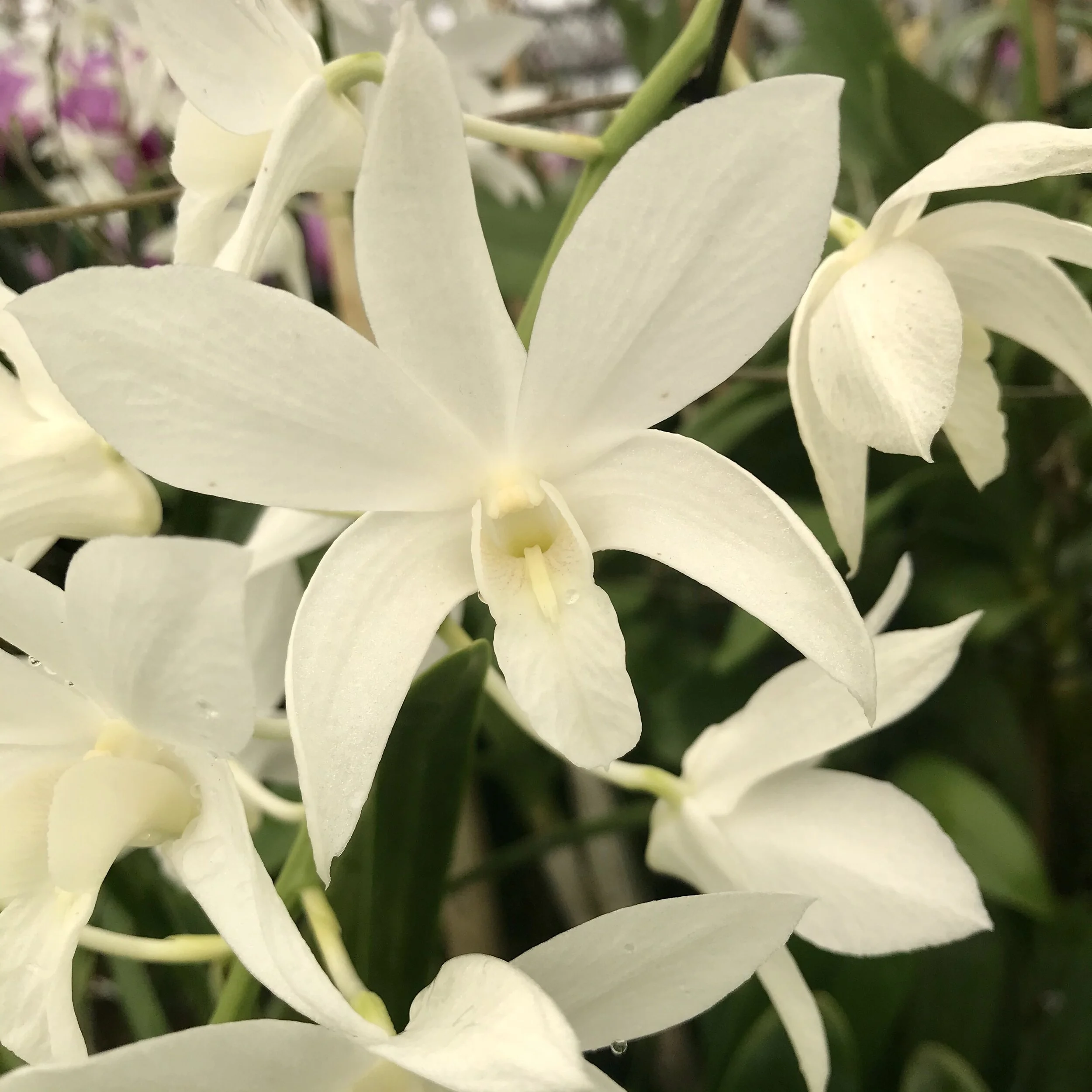
(Den. Fiftieth State x Dendrobium speciosum)
‘Sato’ mericlone.
Evergreen and hard-caned with an inflorescence of several long-lasting white flowers.
Plants Available: Growing in 4” and 6” pots. An example of the 4” Pot - Sm option is pictured. The 4” Pot option is blooming-size. The 6” Pot option is mature (first bloom/spike or previously bloomed).
Orchid Care: Grow in high light—very bright, but indirect sun. Water generously and frequently in spring and summer during active growth, but reduce watering during the cooler months. Roots should not remain wet for extended periods. Canes may start to wrinkle slightly during this dry, cool period.
We recommend potting rather than mounting this variety. Repotting should be done only during active growth (spring, summer) when plants are producing new canes and have active root tips. Plants should be snug in their pots.
-
10.06.26

(var. luzonicum x sib)
Dendrobium species, native to the Philippines, where it can be found growing epiphytically in tropical pine forests.
Buds form near the tips of the canes between the leaves and bloom in clusters of white flowers.
Grown from seed, so flower characteristics vary somewhat from plant to plant.
Plants Available: Growing in 4” pots. An example of the 4” Pot option is pictured. Orders will be filled with plants in bud or bloom as blooming season and blooming stock permit; otherwise, mature plants, previously bloomed.
Orchid Care: Grow in high light (bright, but indirect) and high humidity. Watering should be adjusted by season and temperature. Water generously in spring and summer while plants are actively growing. Do not allow plants to dry completely. Reduce water gradually after new growths mature in the fall, allowing for only slight drying between waterings.
-
05.29.26

(Dendrobium carronii × Dendrobium mirbelianum)
Compact antelope Dendrobium with vibrant magenta petals.
Mericlone.
Plants Available: Growing in 4” pots. An example of the 4” Pot option is pictured. Orders will be filled with plants in spike/bud/bloom as blooming season and blooming stock permit; otherwise, mature plants which have bloomed previously.
Orchid Care: Generally easy to grow, particularly alongside Cattleyas. Provide high light and good air circulation. Water generously while plants are actively growing in spring and summer, but allow plants to dry out between watering. A medium or large aggregate bark mix that drains freely is recommended for potted plants. Reduce watering during fall and winter. Fertilize weakly, weekly.
-
06.13.25
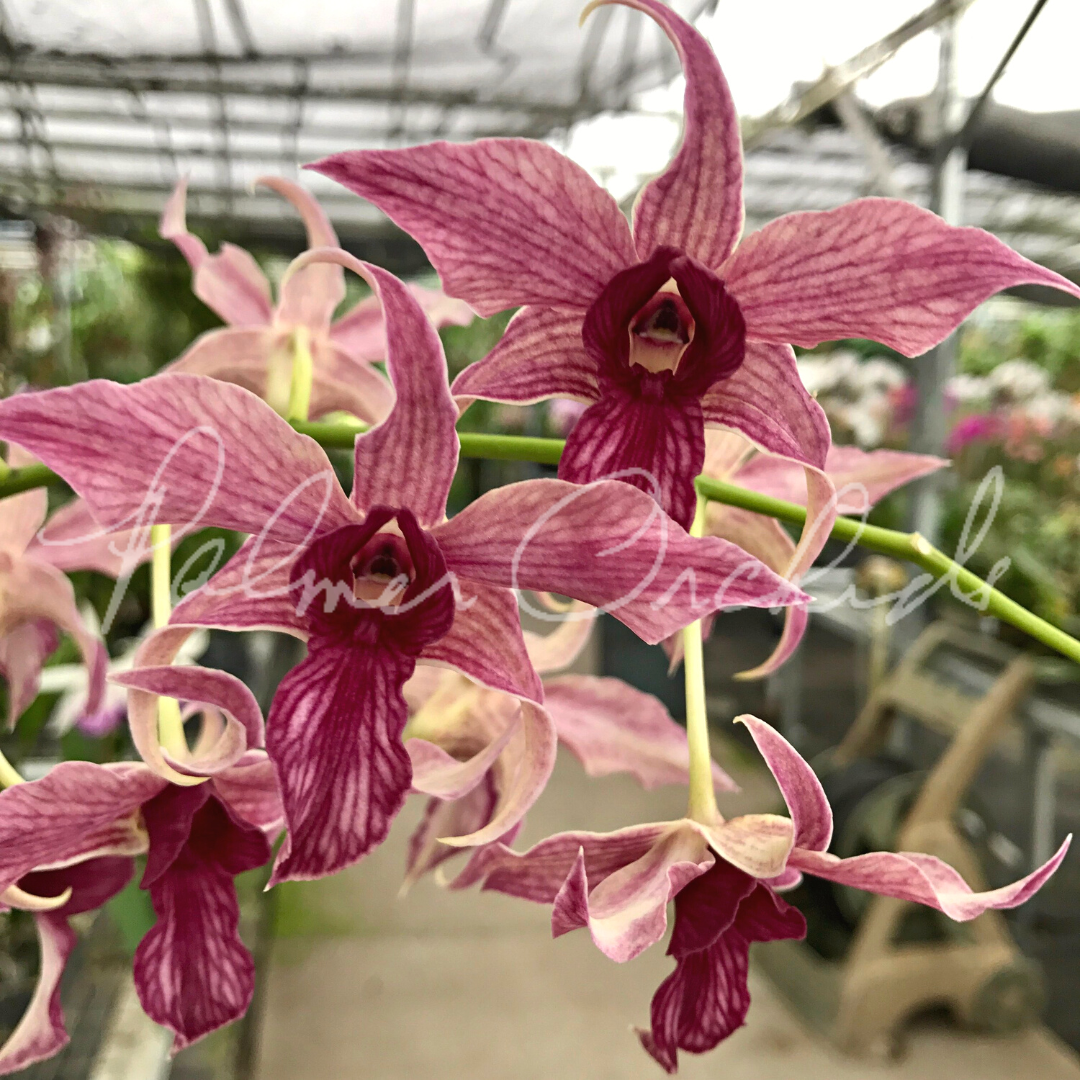
(Den.Big Alex x Dendrobium spectabile)
Grown from seed so flower characteristics vary somewhat from plant to plant.
Plants Available: Growing in 4” Pots. An example of the size available is pictured.
Orchid Care: Grow in very bright light, though plants should be shaded (filtered sun) during the hottest hours of the day when the sun is most intense. Pot in a medium aggregate bark mix and top dress with time release fertilizer annually. As a rule, the mix and root system should dry between waterings. Younger plants may require water more frequently than larger, mature plants.
—
10.17.26
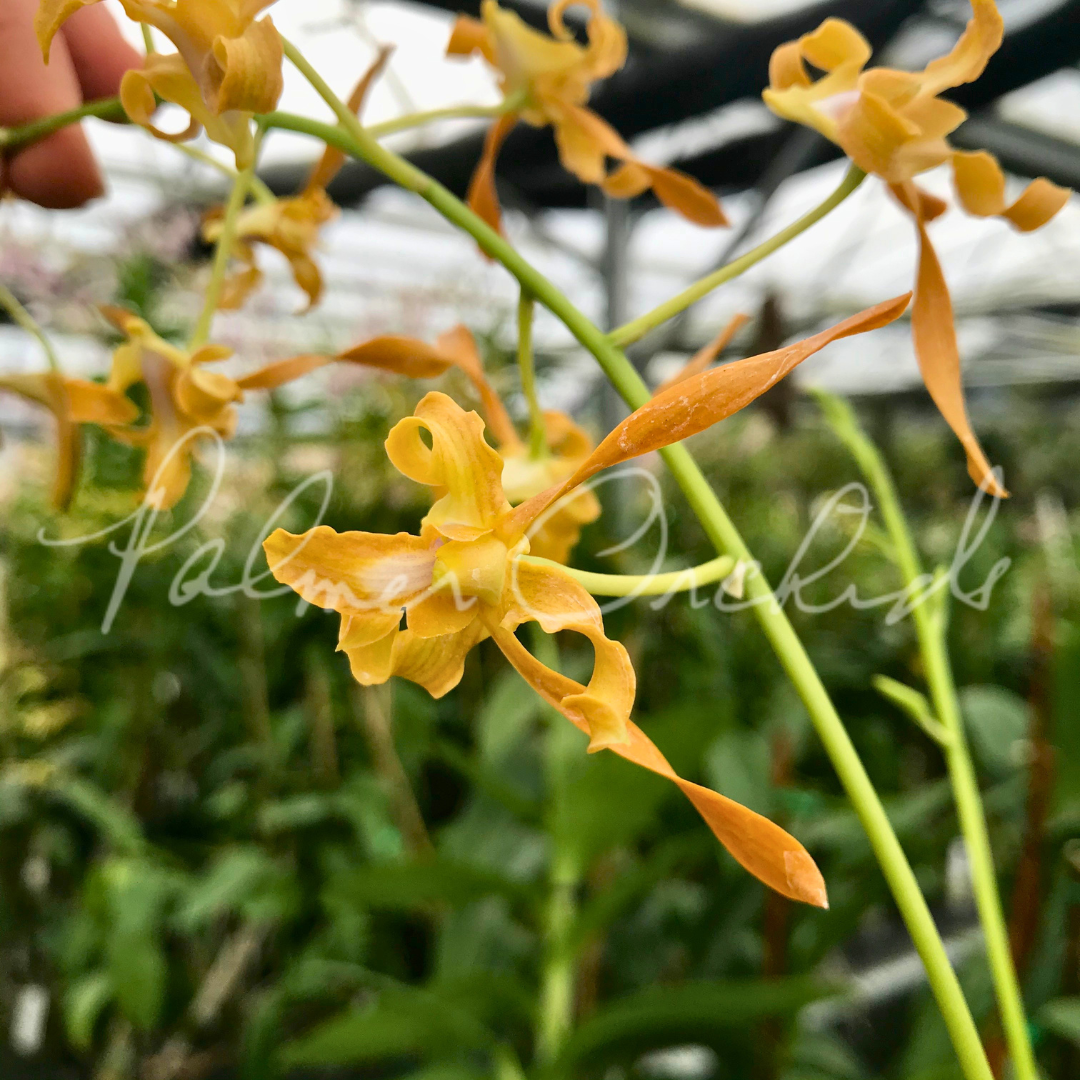
x sib
Orange/tangerine-colored antelope Dendrobium species.
Grown from seed so flower will vary somewhat from plant to plant.
Plants Available: Growing in 2” and 4” pots. An example of the 2” Pot option is pictured. Plants in both pot sizes are overgrown and ready to be repotted (before the end of the growing season). The 2” Pot option may be blooming-size or previously bloomed. The 4” Pot option is mature, as pictured.
Orchid Care: Grow in bright indirect light with strong air circulation and moderate to high humidity. Water generously while plants are putting out new roots and growth (spring and summer). Reduce water and fertilizer during the cooler months.
—
08.01.26
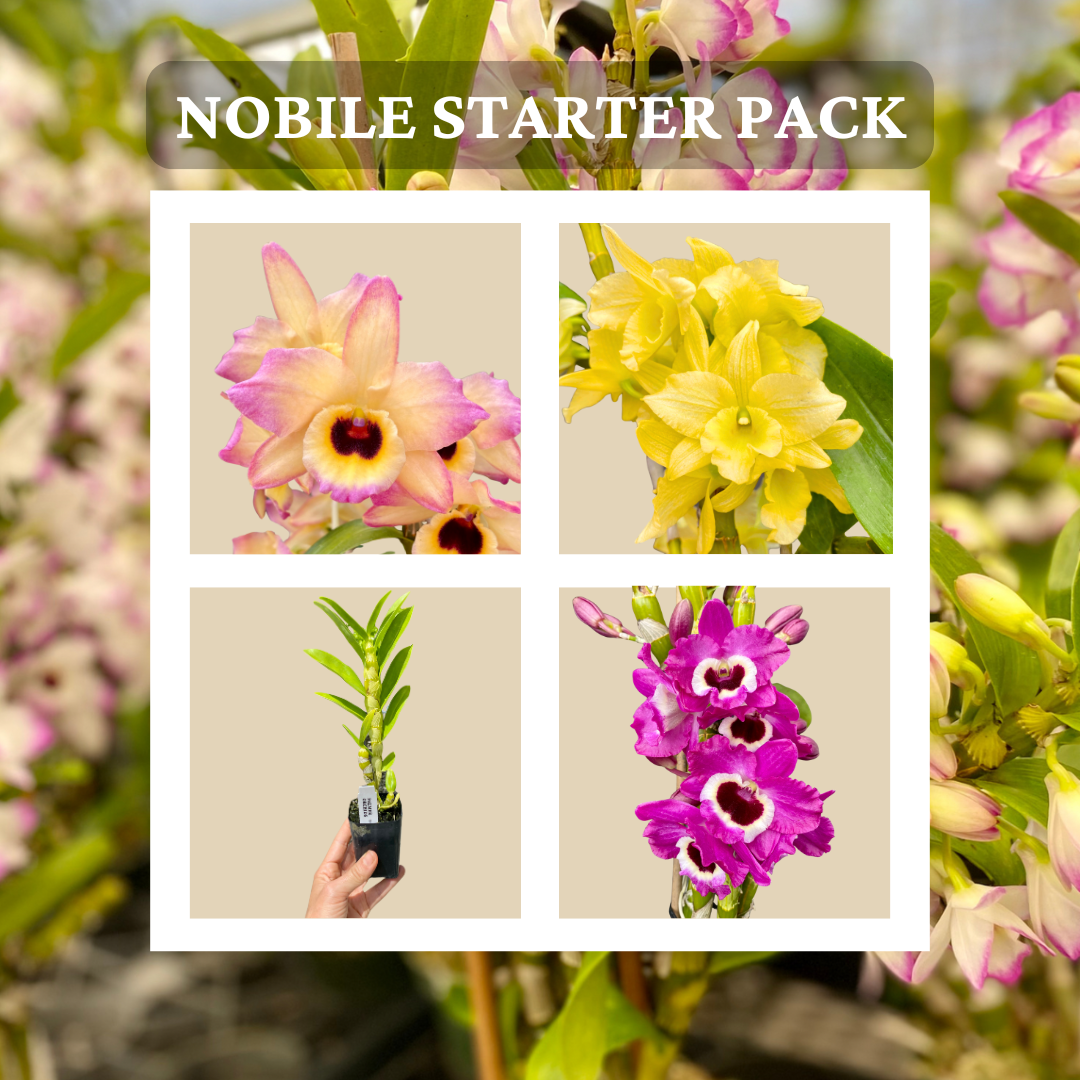
Grower's choice assortment of four Nobile-type Dendrobium hybrids.
This starter pack of Den. nobile types is a great way to try your hand at a set of fragrant, pendulous Dendrobiums in a variety of color forms.
The blooms pictured are examples of the color combinations available but are not necessarily the specific clones available in this assortment.
Plants Available: Growing in soft pots and 2" pots. Examples of the plants in each 4-pack are pictured.
The Soft Pot 4-Pack includes the following four varieties:
Den. Yellow Diamond (yellow w/ dark center)
Den. Tianmu Amber (yellow)
Den. Red Army (magenta red w/ dark center ringed in white)
Den. Crown (white w/ dark pink picotee and yellow center)
The 2” Pot 4-Pack may include any four of the following varieties:
Den. Yellow Diamond (yellow w/ dark center)
Den. Tianmu Amber (yellow)
Den. Red Army (magenta red w/ dark center ringed in white)
Den. Crown (white w/ dark pink picotee and yellow center)
Den. Tianmu Purple Botan (magenta w/ light yellow and white center)
Den. Sunny Egg (white w/ yolk yellow center)
Den. Lucky Girl (white w/ yellow center and pink petal tips)
Den. Tianmu Red Model (magenta red w/ dark center ringed in light yellow)
* Additional varieties may be included in the 2” Pot 4-Pack at grower’s discretion.
Orchid Care: Grow in high light (e.g. 30%-50% shade). Mature plants can be acclimated to direct sun, but younger plants are best grown in high, filtered light (e.g. less than 5000 fc).
Plants in soft pots are ready for immediate repotting. Plants in 2” pots can also be potted up if putting out new growth and roots. Note that repotting for nobile-types is best done in late spring and early summer. Plants should not be repotted in fall/winter.
Water and fertilize regularly during active growth, but give plants a "dry rest" in the cooler months. During this time plants should be watered sparingly and fertilized rarely.
Note: Nobile-type Dendrobiums are deciduous—you can expect them to drop leaves during their rest period. Plants require a cool, dry rest in fall/winter to initiate flowering.
-
09.05.25

(Den. Dawn Maree × Den. Lori Tokunaga)
Dendrobium section Formosae hybrid. Buds emerge directly from the cane at the leaf axial, typically in pairs or clusters. Blooms are creamy to light green with a red-orange throat and waxy in substance, which provides for a long-lasting flower.
The canes of this variety are naturally semi-pendulous when not staked or tied upright. Bear this in mind as the new growth emerges. Staking or allowing the growths to cascade is simply a matter of preference since the new growth will be self-supporting.
Grown from seed so flower characteristics vary somewhat from plant to plant.
Plants Available: Growing in 4” pots. An example of the smaller size is pictured. Orders will be filled with plants in bud or bloom as blooming season and blooming stock permit.
Orchid Care: Grow in bright, diffused light. Keep moist in spring and summer while plants are actively growing. If potted in an open mix that drains freely and does not easily saturate, you can easily grow them alongside your Vandas, watering daily. Reduce watering somewhat during the cooler months, but plants are evergreen* and do not require a dry rest. Plants should be tight in their pots.
*Note: Although this is not a deciduous variety, some leaf drop is normal, particularly in response to stress. It is common for the canes on Formosae-type Dens like this one to shed a few leaves after shipping. Just give them a good watering and protect from extremes (e.g. in terms of light and heat) while they acclimate to your growing space.
-
08.27.25
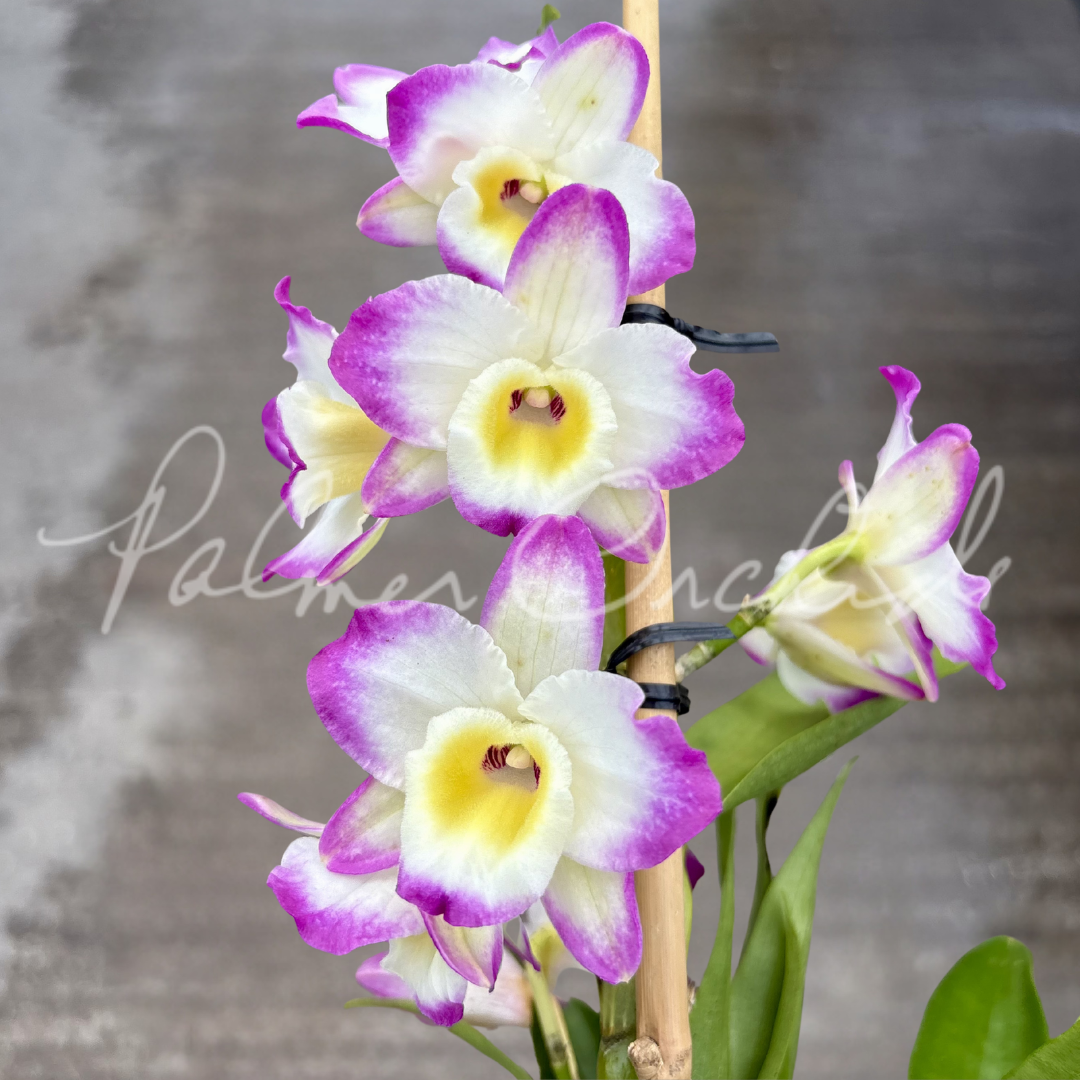
Registered Name: Den. Gold Diamond
(Den. Lucky Angel x Den. Spring Angel)
‘DMP008’ mericlone.
The flowers pictured are from the first plants of the crop to bloom (February 2025).
Blooms in the spring.
Plants Available: Growing in 4" pots. Examples of the 4” Pot option are pictured. Orders will be filled with plants in bud/bloom as blooming season and blooming stock permit; otherwise mature plants, previously bloomed.
Orchid Care: Grow in high light (e.g. 30%-50% shade). Mature plants can be acclimated to direct sun, but younger plants are best grown in high, filtered light (e.g. less than 5000 fc). Water and fertilize regularly during active growth, but give plants a "dry rest" in the cooler months. During this time plants should be watered sparingly and fertilized rarely.
Note: Nobile-type Dendrobiums are deciduous—you can expect them to drop leaves during their rest period. Plants require a cool, dry rest in fall/winter to initiate flowering.
-
02.28.26

Latouria-type Dendrobium. Blooms in clusters of creamy white flowers with purple spots and a vibrant purple lip. Generally easy to grow and flower. Blooms can last several weeks. Plants may bloom twice a year.
Grown from seed so flower characteristics vary somewhat from plant to plant.
Plants Available: Growing in 4” pots. Orders will be filled with plants in spike/bud/bloom as blooming season and blooming stock permit; otherwise, mature plants which have bloomed previously.
Orchid Care: Grow in bright light and moderate humidity. Direct sun is not recommended. Plants should be evenly kept moist (not wet or soggy) and fertilized weakly, weekly. Grow potted in a medium aggregate bark mix that allows for regular watering without becoming saturated or stagnant. We recommend baskets or clay pots if plants are to be grown hanging.
—

(Dendrobium atroviolaceum × Dendrobium johnsoniae)
Latouria-type Dendrobium and primary hybrid of Den. species Dendrobium atroviolaceum and Dendrobium johnsoniae.
Blooms in clusters of medium-sized white flowers, marked by vivid purple striations on the interior lip. Petals have light or heavy spotting on the anterior side. Blooms can last 6-12 weeks.
Among members of the Latouria group, this variety is intermediate in size.
Grown from seed so flower characteristics may vary somewhat from plant to plant. Plants currently available are semi-alba x sib.
Plants Available: Growing in 4” pots. Examples of available sizes are pictured. Orders will be filled with plants in spike/bud/bloom as blooming season and blooming stock permit; otherwise, mature plants, previously bloomed.
Orchid Care: Hard-caned and evergreen Latouria Dens like this one grow best in warm conditions and medium-high light. Water generously and fertilize regularly while plants are actively growing in spring and summer. The potting media should be kept evenly moist with only slight drying allowed in between. When day length shortens and temperatures cool, reduce water and fertilizer somewhat to keep plants a little on the drier side throughout the cooler, drier months.
-
07.11.24
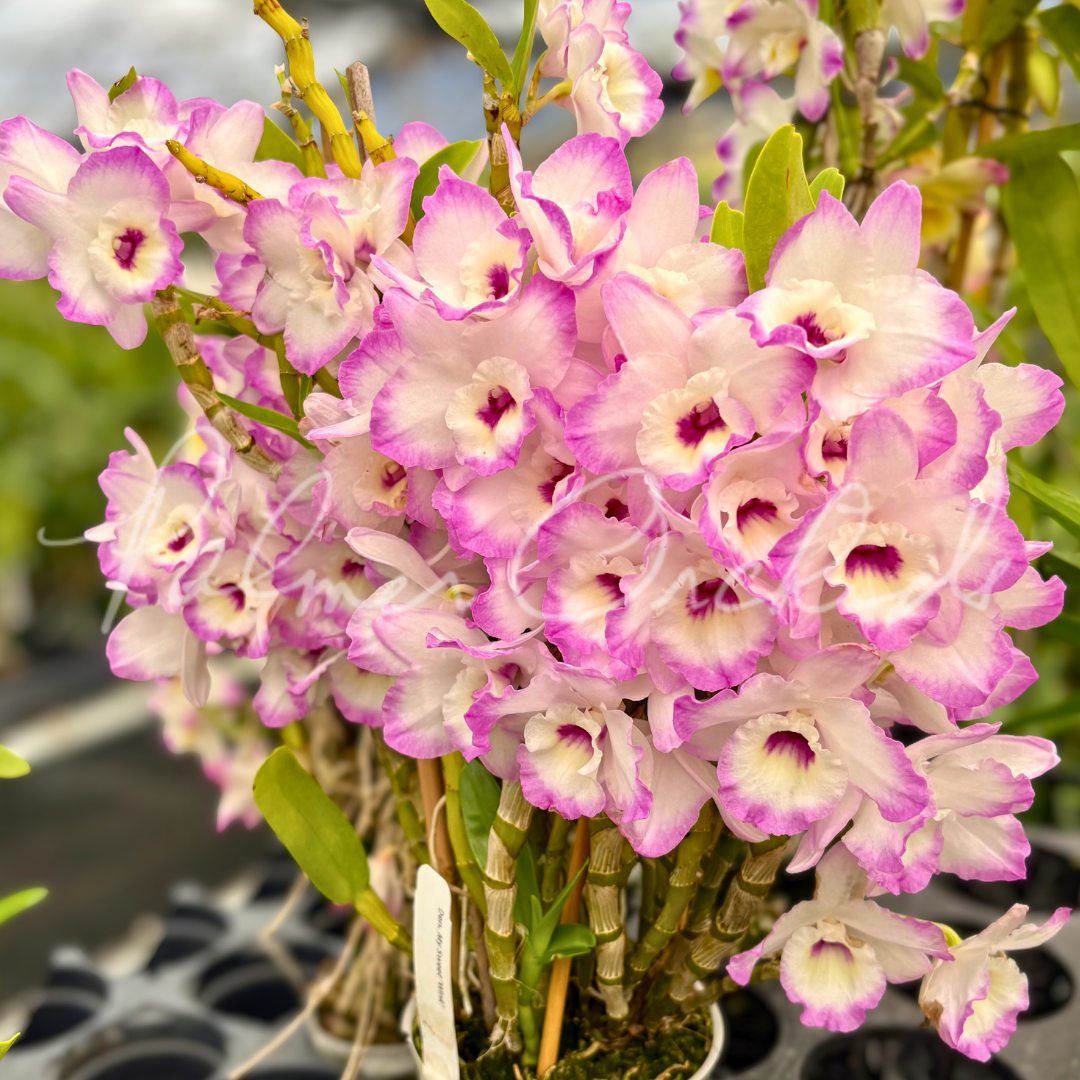
(Den. Sweet Pinky x Den. Sachi)
‘Wink’ mericlone.
The blooms pictured are from the first plants of the crop to bloom (February 2025).
Blooms in the spring.
Plants Available: Growing in 4" pots, blooming-size. An example of the size available is pictured.
Orchid Care: Grow in high light (e.g. 30%-50% shade). Mature plants can be acclimated to direct sun, but younger plants are best grown in high, filtered light (e.g. less than 5000 fc). Water and fertilize regularly during active growth, but give plants a "dry rest" in the cooler months. During this time plants should be watered sparingly and fretilized rarely.
Note: Nobile-type Dendrobiums are deciduous—you can expect them to drop leaves during their rest period. Plants require a cool, dry rest in fall/winter to initiate flowering.
-
08.28.25

(Den. Roy Tokunaga × Den. rhodostictum)
Grown from seed so flower characteristics vary somewhat from plant to plant.
Plants Available: Growing in 4” pots. The plant pictured is an example of the 4” Pot option currently available. Orders will be filled with plants in spike/bud/bloom as blooming season and blooming stock permit; otherwise, mature plants, previously bloomed.
Orchid Care: Hard-caned and evergreen Latouria Dens like this one grow best in warm conditions and medium-high light. Water generously and fertilize regularly while plants are actively growing in spring and summer. The potting media should be kept evenly moist with only slight drying allowed in between. When day length shortens and temperatures cool, reduce water and fertilizer somewhat to keep plants a little on the drier side throughout the cooler, drier months.
-
10.27.23
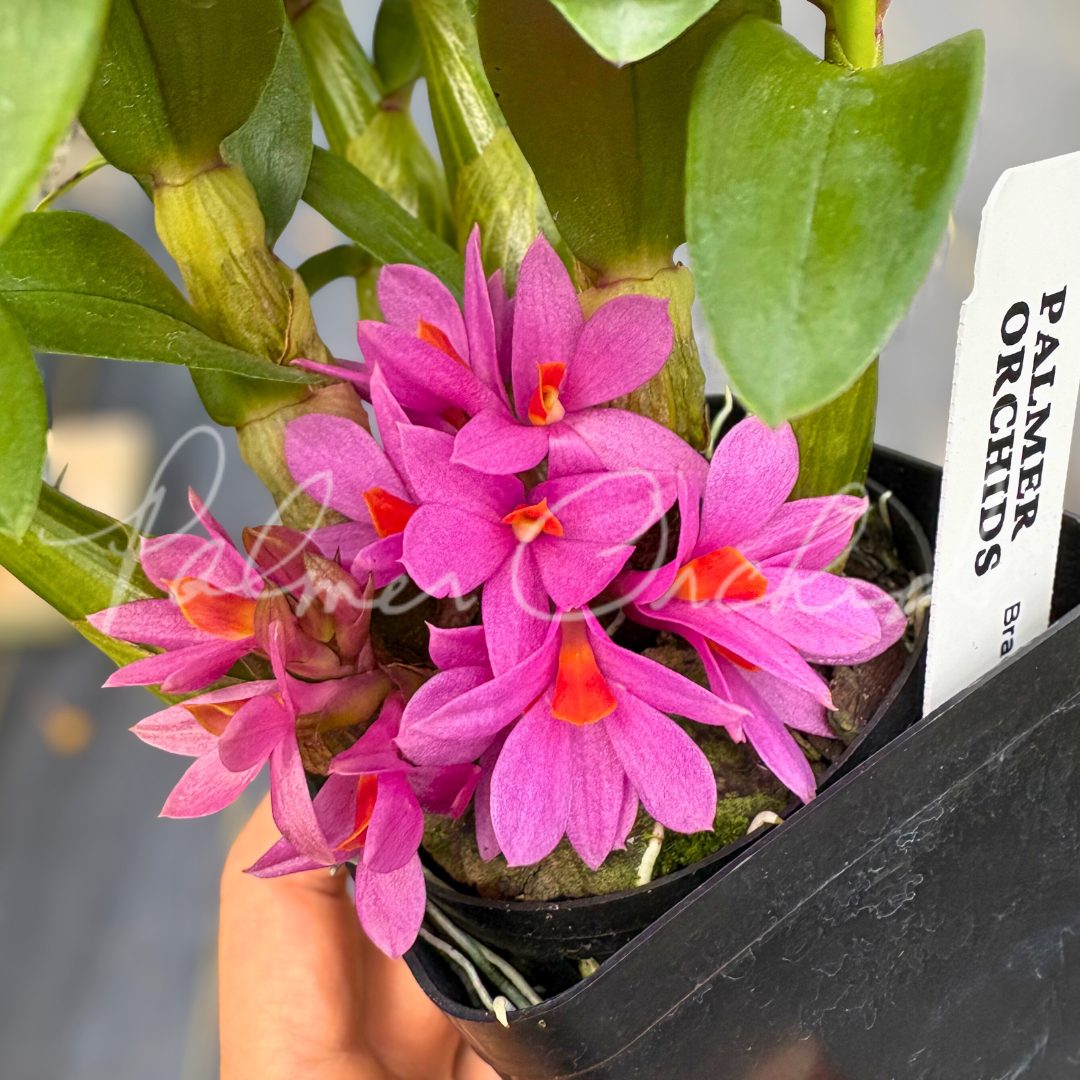
(Dendrobium bracteosum x Dendrobium laevifolium)
Den. Hibiki is among the first generation offspring of Dendrobium laevifolium and blooms in similar lovely little pink clusters. Compact growing. Typically blooms twice a year.
Mericlone.
Plants Available: Growing in 4” pots. Examples of the 4” Pot option are pictured. Orders will be filled with plants in bud/bloom as stock permits.
Orchid Care: Grow in bright shade/dappled light and moderate humidity. Plants should be watered generously in Spring and Summer, when putting on new growth. Reduce water and fertilizer during the cooler months as growth slows. Hibiki can be grown potted in an open, free-draining potting media. Or if mounting is preferable, we recommend baskets. In either case, the plant should be snug in its pot/basket.
—
08.29.25
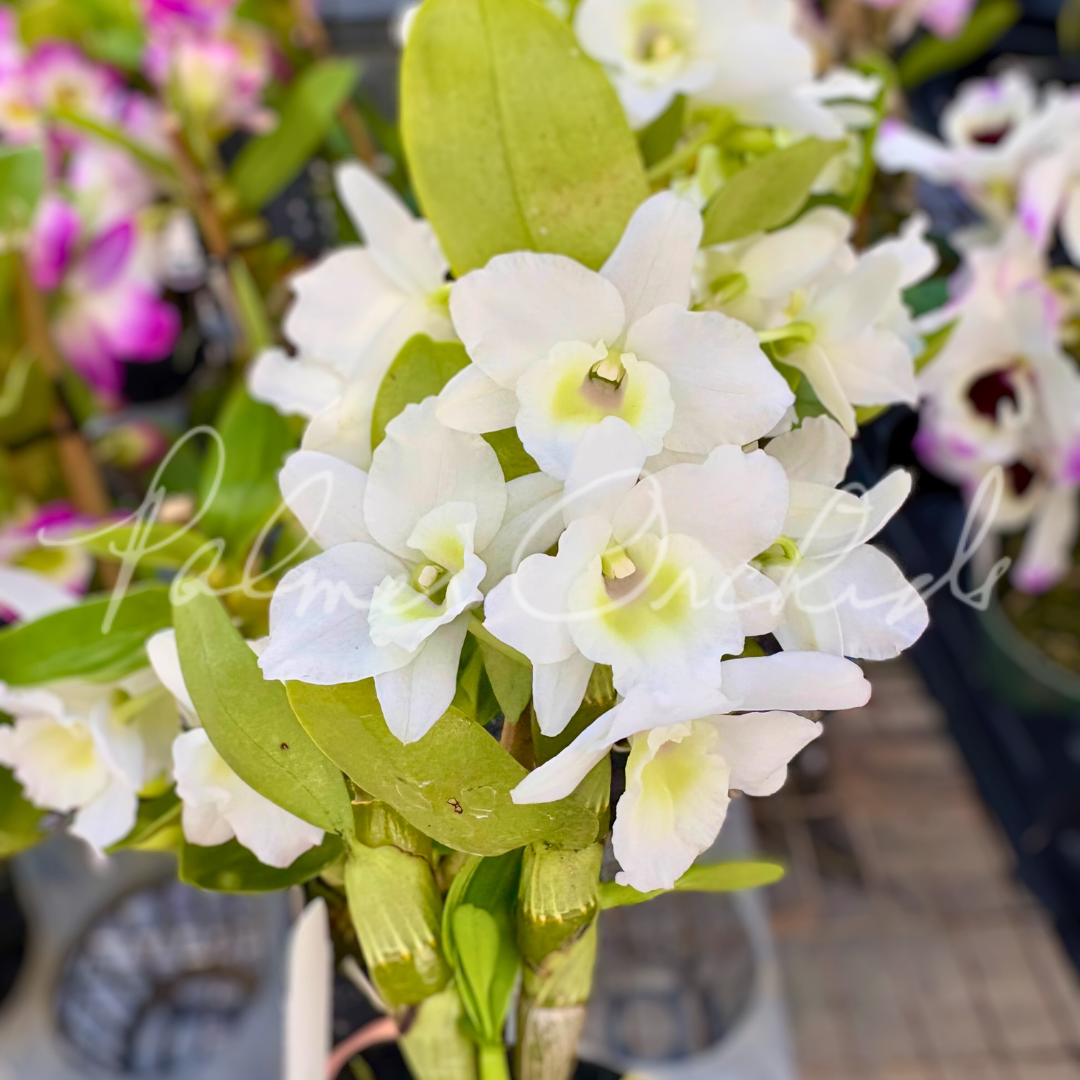
(Den. Spring Snow x Den. Tianmu Green Elf)
‘DMP037’ mericlone.
The blooms pictured are from the first plants of the crop to bloom (February 2025).
Blooms in the spring.
Plants Available: Growing in 4" pots. An example of the 4” Pot option is pictured.
Orchid Care: Grow in high light (e.g. 30%-50% shade). Mature plants can be acclimated to direct sun, but younger plants are best grown in high, filtered light (e.g. less than 5000 fc). Water and fertilize regularly during active growth, but give plants a "dry rest" in the cooler months. During this time plants should be watered sparingly and fertilized rarely.
Note: Nobile-type Dendrobiums are deciduous—you can expect them to drop leaves during their rest period. Plants require a cool, dry rest in fall/winter to initiate flowering.
-
08.27.25

(Den. Angel Baby x Den. Red Emperor)
Mericlone.
The blooms pictured are from the first plants of the crop to bloom (February 2025).
Blooms in spring.
Plants Available: Growing in 4" pots, blooming-size. An example of the 4” Pot option is pictured.
Orchid Care: Grow in high light (e.g. 30%-50% shade). Mature plants can be acclimated to direct sun, but younger plants are best grown in high, filtered light (e.g. less than 5000 fc). Water and fertilize regularly during active growth, but give plants a "dry rest" in the cooler months. During this time plants should be watered sparingly and fertilized rarely.
Note: Nobile-type Dendrobiums are deciduous—you can expect them to drop leaves during their rest period. Plants require a cool, dry rest in fall/winter to initiate flowering.
-
08.27.25

(Den. Super Star × Den. Warabe)
‘Kumi’ mericlone.
This is a dwarf variety of a Dendrobium nobile-type hybrid. Plants will stay relatively short and compact. Flowers are pinky purple with a white center and lightly fragrant.
Easy to grow, great for mounting, and fragrant. Although plants are staked upright for greenhouse/commercial growing, the canes of Den. nobile hybrids are naturally pendulous. They require a dry rest in fall/winter until they produce buds late winter/early spring.
Plants Available: Growing in 4” pots. Examples of the sizes available are pictured. Orders will be filled with plants in bud/bloom as blooming season and blooming stock permit; otherwise, mature plants, previously bloomed.
Orchid Care: Grow in very bright indirect light. Blooming-size plants can be acclimated to direct sun, but will thank you if you give them shade/filtered sun during the hottest hours of the day during the summer (typically 11-3). Great for mounting on most palms. Water and fertilize regularly during active growth, but give plants a dry rest in the cooler months. At our nursery, this period is typically from Thanksgiving through Feb/March.
Note: Nobile-type Dendrobiums are deciduous—you can expect leaves to yellow and drop during their cool, dry rest period.
-
03.15.25

(Den. Royal Chip x Roy Tokunaga semi-alba)
A new addition to the Latouria line. This hybrid blooms in clusters of medium-sized white flowers with pin-prick purple spots and purple striations on the interior lip. Petals have a pink-purple blush, as if lightly dusted with color
Blooms last several weeks.
Among members of the Latouria group, this variety is intermediate in size.
Grown from seed so flower characteristics may vary somewhat from plant to plant.
Plants Available: Growing in 4” pots. An example of the 4” Pot option is pictured. Orders will be filled with plants in spike/bud/bloom as blooming season and blooming stock permit; otherwise, mature plants, previously bloomed.
Orchid Care: Hard-caned and evergreen Latouria Dens like this one grow best in warm conditions and medium-high light. Water generously and fertilize regularly while plants are actively growing in spring and summer. The potting media should be kept evenly moist with only slight drying allowed in between. When day length shortens and temperatures cool, reduce water and fertilizer somewhat to keep plants a little on the drier side throughout the cooler, drier months.
-
07.11.24

(Den. Norma Jackson x Den. Blue Twinkle)
If you’re new to Antelope Dendrobiums and looking to try your hand at this twisty-petaled pack of plants, Den. Hawaiian Punch is the perfect place to start. This classic hybrid is easy to grow and bloom and can really make a splash as a tropical yard orchid (given the right grow zone). Typically produces multiple bloomspikes per bloom period once mature.
Grown from seed so flower will vary somewhat from plant to plant. The large bloom spikes pictured first are examples from mature plants. The smaller spike is the first bloom from a younger plant.
Easy to grow and bloom and a great orchid for the patio, yard, or landscaping in subtropical environs. Plants can take on significant stature over time.
Plants Available: Growing in 4” pots. The plant pictured in is an example of the 4” Pot option, which is a blooming-size plant. The 4” Pot - Mature option is a larger, mature plant. Orders for the latter will be filled with plants in spike/bud/bloom as available; otherwise, mature plants previously bloomed.
Orchid Care: Grow in very bright indirect light with strong air circulation and moderate to high humidity. Some direct sun early or late in the day is okay. Water heavily while plants are in active growth. Reduce water and fertilizer somewhat during the cooler months, but continue to provide bright light during this time.
-
10.07.25

(Little Atro x normanbyense)
Fragrant Latouria-type Den. that blooms in a cluster of spotted, creamy white flowers with a vibrant purple throat.
Grown from seed.
Plants Available: Growing in 4” pots. Examples of the size available are pictured. Orders will be filled with plants in bud/flower as blooming season and blooming stock permit. Otherwise, mature plants, previously bloomed.
Orchid Care: Generally easy to grow. Provide dappled to bright, indirect light and moderate humidity. Plants should be kept moist during active growth (spring and summer). But reduce water and fertilizer somewhat during the cooler months. Plants should be snug in their pots.
-
12.04.24
(Den. Blue Twinkle x Dendrobium antennatum)
A stocky, compact antelope Den with coerulea-purple flowers whose colors become bolder when grown in higher light.
Mericlone.
Plants Available: Growing in 4" pots. Examples of the size available are pictured. Orders will be filled with plants in spike/bud/bloom as blooming season and blooming stock permit; otherwise, mature plants which have bloomed previously.
Orchid Care: Generally easy to grow, particularly alongside Cattleyas. Provide high light and good air circulation. Water generously while plants are actively growing in spring and summer, but allow plants to dry out between watering. A medium or large aggregate bark mix that drains freely is recommended for potted plants. Reduce watering during fall and winter.
-
09.04.26